
Australia to Implement International Student Ratio Limit in 2025
Australia to Implement International Student Ratio Limit in 2025
The Australian government has decided to introduce a limit on the number of international students enrolled in Australian universities from January 1, 2025, in order to meet its policy target of keeping the growth of the inward migration population to a strict maximum of 260,000 in the financial year 2024-2025, which will be capped at 40%. At that time, the proportion of overseas students enrolled in major Australian universities will be limited to 40%.

Image Source: Sourced from the Internet
I. Status of data
From the latest data, Australia has 671,200 overseas students in 2019, which has grown to 780,100 by 2024. Currently, about 10 universities have an overseas student ratio of 40% or more, including the University of Sydney, the University of Melbourne, Monash University, the University of Queensland, the University of New South Wales, the University of Wollongong, the Royal Melbourne Institute of Technology, the University of Torrance and so on. The cap on the number of overseas students was set based on 2019 data. On this basis, the University of Sydney would need to cut 12,150 places and the University of Melbourne would need to cut 7,725 overseas student places.
While many universities and colleges are pressing for a one-year delay in implementation to give them a cushion, Australia's Education Minister is adamant that the government is determined to legislate and set the cap in time for the 2025 academic year.
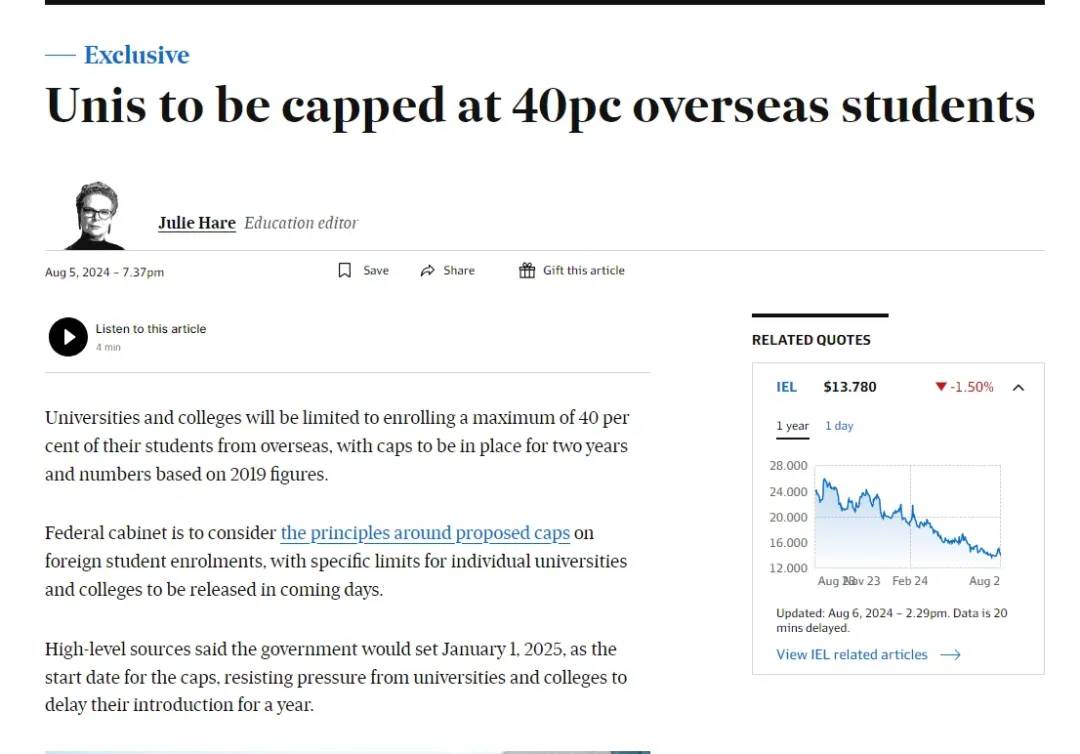
Image Source: Sourced from the Internet
Reactions
Once the news was released, it triggered extensive discussions on the Internet.
Vicki Thomson, CEO of the Australian Eight Schools Alliance, said, “This legislation will damage Australia's international reputation, make it difficult for universities to control their budgets in 2025, and will require the withdrawal of places that students have already secured!” At the same time, this policy will have a significant impact on the economy. For the eight-university consortium members alone, it would cost Australia more than $5.3 billion in lost economic output and more than 22,500 jobs.
However, there are others who see it differently. Peter Varghese, Chancellor of the University of Queensland, believes the 40 percent limit is reasonable and protects the integrity of the institution. He points out: “The cap on international students is designed to prevent our institutions from becoming global corporations rather than public institutions focused on education. If there had been no limit on numbers, the proportion of international students could have exceeded 50 percent.” Overall, however, concerns about this policy are strong.
Possible Impact
After the announcement of the specific policy, those schools that are more popular and attractive will be more affected. For applicants, schools and majors that are already difficult to apply for, the difficulty of subsequent applications will be further increased, and the following situations may occur: raising the application threshold and reducing the number of applicants; implementing a screening system and selecting the best candidates; shortening the time for accepting offers and the deadline for popular majors; and possibly leading to an increase in tuition fees.