The Amazon Milk Tree Frog: Nature’s Vibrant Green Amphibian with a Milky Defense


Animal Information
The Amazon Milk Tree Frog: Nature’s Vibrant Green Amphibian with a Milky Defense

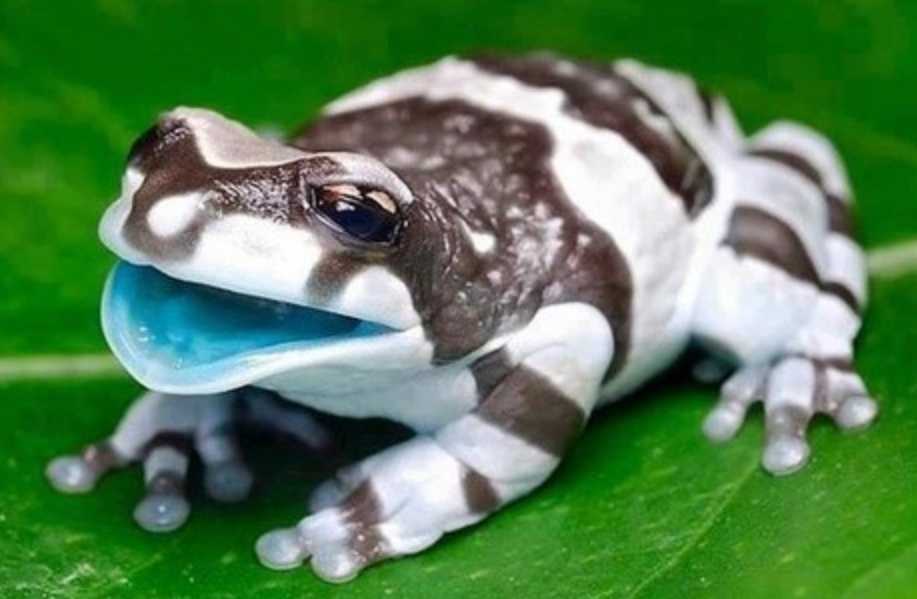
Native to the rainforests of northern South America, the Amazon milk tree frog (Trachycephalus resinifictrix) is a striking amphibian renowned for its vivid coloration and unique defensive adaptation. Found in the canopy of tropical forests from Venezuela to Brazil, this arboreal frog has captivated herpetologists with its bold appearance and the milky-white toxin it secretes when threatened.

A Canopy Dweller with Eye-Catching Traits

  • Color and Camouflage
    The frog’s dorsal skin shimmers in bright lime green, often dotted with irregular white or yellow patches, while its underside and limbs display rich blue or purple hues. This vibrant palette serves as a warning to predators, signaling its toxicity. When resting, it tucks its colorful limbs beneath its body, relying on green dorsal patterns to blend with leaves.
  • Physical Adaptations
    Growing 7–10 cm in length, it has large, adhesive toe pads for climbing trees and a stocky build. Its eyes are large and golden, with horizontal pupils that enhance night vision. When threatened, it inflates its body to appear larger and secretes a milky-white substance from skin glands—a sticky, toxic blend that irritates predators’ mouths.

Life Cycle and Rainforest Role

  • Breeding in the Canopy
    Females lay eggs in tree holes filled with water, where tadpoles develop. Males guard the clutch, calling at night with a deep, resonating croak. Tadpoles feed on algae and detritus, completing metamorphosis within weeks.
  • Ecological Balance
    As insectivores, they control populations of mosquitoes, moths, and other invertebrates. Their toxicity makes them unpalatable to most predators, though some snakes and birds have evolved resistance. Their presence indicates healthy rainforest ecosystems, as they rely on intact canopies and standing water in trees.

Conservation and Cultural Notes

While not currently endangered, the Amazon milk tree frog faces threats from deforestation, habitat fragmentation, and climate change. In local folklore, its vibrant colors are sometimes associated with protective spirits, though it is not widely used in traditional medicine. Today, it serves as an ambassador for rainforest conservation, appearing in educational programs to highlight the importance of amphibians in tropical ecosystems.


With its neon-green armor and milky defense, this frog embodies the Amazon’s evolutionary creativity—proving that in the world’s most biodiverse forests, even small creatures can thrive through bold colors and clever chemistry.

Latest Stories
Entertainment News1 minute readSalma Hayek’s journey to becoming a global beauty began with small, intentional touches—her grandmother tended to her eyelashes and hair from childhood, nurturing the allure that would later define her. She left college to pursue acting, a bold choice that set her on a path to stardom.
Travel News2 minute readNestled along the Atlantic coast of Picardy in northern France, the Baie de Somme stands out as a unique ecosystem and year-round sanctuary for seal populations. Comprising marshes, mudflats, and sandbars, this triangular expanse serves as a vital stopover for migratory birds and hosts one of Europe's largest colonies of harbor seals (Phoca vitulina), attracting tens of thousands of visitors annually to witness its natural splendor. Natural Heritage and Ecol
Industry News1 minute readForeign media reports that Nvidia and AMD have received U.S. government support to restart AI chip exports to China. Nvidia announced it will resume selling the China-customized H20 chip and launch a new compliant product, the RTXPRO GPU. CEO Jensen Huang stated in Beijing that the Chinese market is "vital" to the company, with H20 ready: "We are very pleased to ship as soon as possible."
Sports News1 minute readSports emerged as a key focus at the 4th International Development Finance Conference, where International Olympic Committee (IOC) Member HRH Prince Feisal Al Hussein emphasized that sports are far more than a form of entertainment—they act as a powerful tool for economic and social transformation.
Sports News2 minute readDespite a string of failed bid attempts in recent years, Germany remains enthusiastic about redefining its relationship with the Olympic Movement through bids from Berlin, Hamburg, Munich, and the Rhine-Ruhr region. These cities are competing to host a Summer Olympics between 2036 and 2044, while actively seeking public backing.
Travel News2 minute readLaunched in 1997 by French entrepreneur Michel Guyot and Maryline Martin, the project aims to replicate a 13th-century fortress through “experimental archaeology,” exploring how medieval artisans built without modern tools. Situated in an abandoned sandstone quarry, the site offers stone, timber, and water—ideal for recreating medieval construction conditions.
Travel News1 minute readMer de Glace, known as the largest glacier in France, is a remarkable natural wonder. Located in the Chamonix Valley of the Mont Blanc Massif, it stretches about 7 kilometers in length and reaches a depth of approximately 200 meters.