The Blue-Footed Booby: Galápagos’ Colorful Seabird with a Dashing Mating Dance


Animal Information
The Blue-Footed Booby: Galápagos’ Colorful Seabird with a Dashing Mating Dance

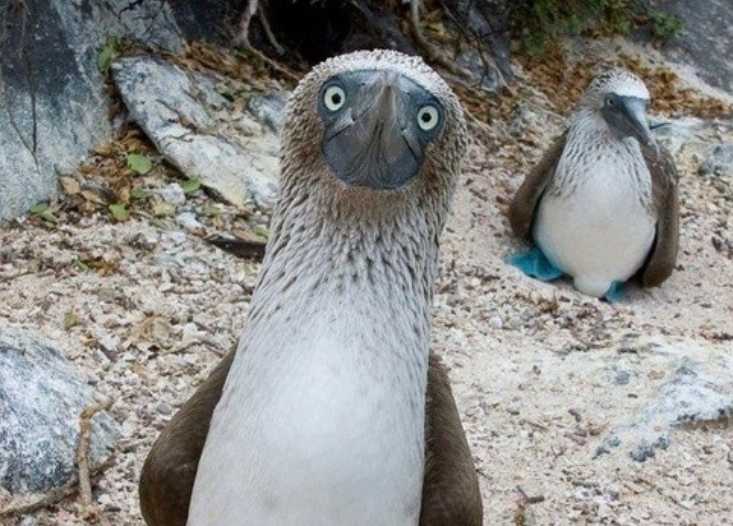
Native to the tropical and subtropical coasts of the eastern Pacific Ocean, the blue-footed booby (Sula nebouxii) is an iconic seabird best known for its most striking feature—bright blue feet that range from a pale turquoise to a vivid cobalt. Made famous by the Galápagos Islands, this charismatic bird has captivated scientists and nature lovers with its unique appearance and elaborate courtship rituals.

A Splash of Blue: Physical Traits and Adaptations

  • Feet as a Living Canvas
    The booby’s blue feet are no accident: their hue comes from carotenoid pigments in its diet of sardines and anchovies. Males typically sport brighter blue feet than females, a trait linked to reproductive fitness. Beyond aesthetics, the feet serve as efficient rudders while swimming and as stabilizers when landing on rocky cliffs.
  • Streamlined Seabird Structure
    Standing 70–90 cm tall with a wingspan of 1.5 meters, the booby has a white body, dark brown wings, and a long, pointed bill adapted for plunge-diving. Its webbed feet, though brilliantly colored, are also perfectly designed for propelling it through water when hunting fish. Juveniles lack the blue hue, developing it as they mature.

Romance on the Rocks: Mating Rituals and Lifestyle

  • The Foot-Flexing Courtship
    During mating season, males perform an elaborate dance: lifting their blue feet high in a slow, exaggerated march, spreading their wings, and calling out to impress females. The brighter the feet and the more energetic the display, the higher the chance of attracting a mate. Females lay 1–3 eggs, and both parents incubate them by resting their blue feet on the clutch to provide warmth.
  • Diving for Dinner
    Blue-footed boobies are exceptional hunters, plunging into the ocean from heights of up to 30 meters, using their sharp eyesight to spot fish below. They can even dive at angles that would disorient other birds, thanks to air sacs under their skin that cushion the impact. They often hunt in groups, herding fish into tight schools before attacking.

Conservation and Cultural Significance

Listed as "Least Concern" by the IUCN, the blue-footed booby faces threats from overfishing (which reduces prey), marine pollution, and introduced predators on nesting islands. In the Galápagos, conservation efforts focus on protecting nesting sites and monitoring population health. The bird’s quirky appearance has made it a symbol of the archipelago’s biodiversity, appearing in documentaries and tourism campaigns. Its blue feet, a blend of biological function and evolutionary showmanship, serve as a reminder of nature’s ability to turn practical traits into works of art—all in the name of love and survival.

Latest Stories
Entertainment News1 minute readAnya Taylor-Joy, born April 16, 1996, in Miami, Florida, holds U.S., British, and Argentine citizenship—a global background that mirrors her ability to inhabit diverse roles across film and television.
Animal Information1 minute readThe Atossa fritillary (Speyeria adiaste atossa), a butterfly once common in Southern California’s mountain regions, is feared extinct, with no confirmed sightings since 1959. Characterized by its broad wings decorated with elegant black spots, the species once thrived across the area’s rugged landscapes.
Entertainment News1 minute readMargot Robbie, the Australian actress, ranked 7th in FHM’s 2015 “World’s Sexiest Women” list, a testament to her striking allure that complements her dynamic career.
Sports News1 minute readWith the 2026 Milano Cortina Winter Olympics approaching, full schedules for Winter Sports World Cups and qualifying events are now available. The newly updated Sports Observer calendar includes 699 exclusive events for 2025 and 2026, plus select major competitions through 2034, serving as a key resource for athletes and fans.
Animal Information1 minute readRed foxes, scientifically known as Vulpes vulpes, are among the most widespread and adaptable carnivores on Earth, thriving across diverse habitats from the frozen tundras of the Arctic to the bustling outskirts of urban centers. Their iconic rusty-red coat, white underbelly, and bushy tail—often tipped with white—make them easily distinguishable, while their pointed ears and sharp snouts reflect their keen senses, critical for survival.
Sports News2 minute readThe International Olympic Committee (IOC) has announced the selection of seven research projects for the 11th edition of the Advanced Olympic Research Grant Programme, which is managed by the IOC’s Olympic Studies Centre (OSC). The chosen projects were selected for their academic quality and relevance to the IOC’s defined priority research areas for the Olympic Movement.
Social News1 minute readMyanmar, in Southeast Asia, evokes images of illicit activities like fraud and organ trafficking for many. Yet behind this grim reputation lies a land of immense potential: 680,000 square kilometers of diverse terrain—mountains, plateaus, and river deltas—fringed by 3,200 km of coastline, with the famed Golden Triangle within its borders.