The Gerenuk: Africa’s Graceful 'Giraffe-Necked' Antelope


Animal Information
The Gerenuk: Africa’s Graceful 'Giraffe-Necked' Antelope

Native to the arid savannas and thornbush plains of East Africa, the gerenuk (Litocranius walleri), often called the "giraffe-necked antelope," stands out with its elongated neck, slender legs, and unique feeding behavior. This medium-sized antelope, found in countries like Kenya, Somalia, and Ethiopia, has evolved extraordinary adaptations to thrive in its harsh, resource-scarce habitat.


A Neck Built for Height: Physical Traits and Adaptations

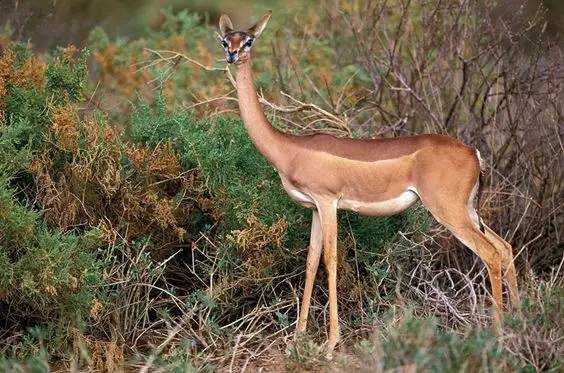
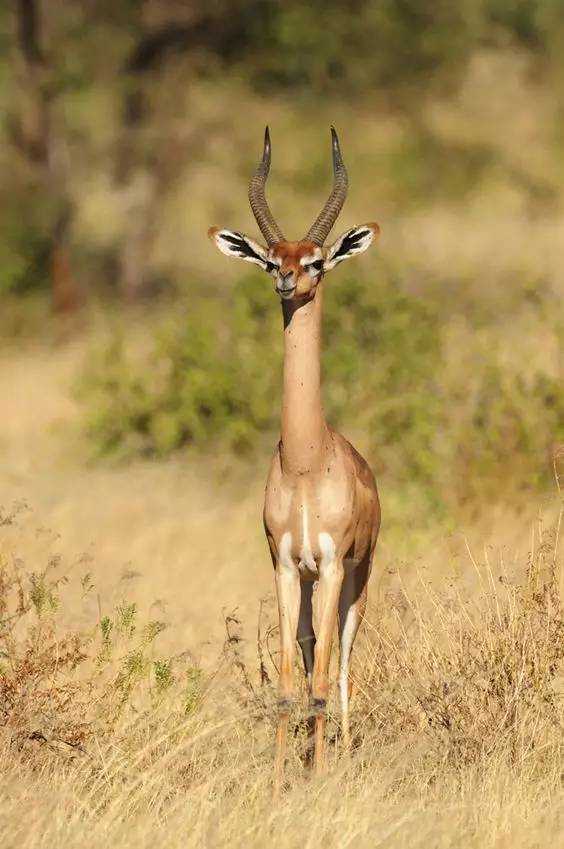
The gerenuk’s most striking feature is its disproportionately long neck, which can reach up to 60 centimeters—allowing it to browse on leaves, shoots, and flowers from trees and shrubs that other antelopes cannot access. Standing 80–100 centimeters at the shoulder, it has a lean body, large eyes, and small, backward-curving horns in males. Its skin ranges from light tan to reddish-brown, blending with dry grasses, while a white underbelly reflects sunlight. When feeding, it rears up on its hind legs, using its prehensile lips to pluck foliage—a behavior resembling a miniature giraffe.
Source: Images from the Internet, if there is any infringement, please contact the removal of


Survival in Arid Lands and Social Behavior

Highly adapted to arid environments, the gerenuk can go long periods without drinking, obtaining moisture from the plants it eats. It lives in small family groups or pairs, with males defending territories through scent marking and displays. Despite its delicate appearance, it is agile and can sprint to evade predators like lions, cheetahs, and hyenas. Females give birth to a single calf, which hides in vegetation for the first few weeks of life.

Conservation Challenges and Ecological Role

Listed as "Near Threatened" by the IUCN, the gerenuk faces threats from habitat loss due to agriculture, livestock grazing, and droughts exacerbated by climate change. Illegal hunting for meat and trophies also impacts populations. As a specialized browser, it plays a crucial role in seed dispersal and shaping vegetation structure in its ecosystem. Conservation projects in East Africa focus on protecting its habitat and promoting coexistence with local communities, highlighting the gerenuk’s unique place in Africa’s diverse wildlife tapestry.


The gerenuk’s elegant form and remarkable adaptations serve as a testament to nature’s ingenuity in arid landscapes. Its ability to thrive where resources are scarce reminds us of the intricate balance between species and their environments, making it a symbol of resilience in the face of ecological challenges.
Latest Stories
Entertainment News1 minute readJenna Marie Ortega, born September 27, 2002, in Coachella Valley, California, has emerged as one of Hollywood’s most dynamic young talents. The Latina actress, known for her sharp performances and unapologetic authenticity, continues to redefine teen stardom.
Animal Information1 minute readReporting from Beijing — In 2016, the global scientific community mourned the passing of Xiaoyinghan (Little Tough Guy), the last known Panamanian tree frog (scientific name: Ecnomiohyla panamensis), which breathed its last in an artificial breeding tank at the Atlanta Botanical Garden. The death of this 12-year-old male frog officially marked the complete extinction of the species from Earth.
Sports News1 minute readThe European Court of Human Rights (ECHR) Grand Chamber ruled Thursday that the Court of Arbitration for Sport (CAS) claimed a significant victory, while South African double Olympic 800m champion Caster Semenya achieved a minor win in her long-running legal battle. The "Semenya v Switzerland" case centers on Semenya’s challenge to World Athletics’ rules on athletes with Differences of Sexual Development (DSD).
Sports News1 minute readFINA’s integrity unit revealed this week that Chinese and Russian athletes at the Singapore World Swimming Championships are undergoing at least twice as many anti-doping tests as competitors from other nations. Data shows Chinese swimmers average 8.80 tests per athlete, with Russians at 8.20—far exceeding the U.S. (4.13), Australia (4.00), and Britain (2.20).
Cultural News2 minute readOn July 12, the UNESCO World Heritage Committee officially inscribed four iconic palaces built by Bavaria’s King Ludwig II onto the prestigious World Heritage List. The ensemble includes Neuschwanstein Castle, Herrenchiemsee Palace, Linderhof Palace, and the Schachen Royal Lodge, celebrated for their visionary architecture and cultural significance. Maria Böhmer, President of Germany’s UNESCO Commission, hailed them as “architectural masterpieces that reflect both the artistic imagination of the Fairy-Tale King and his unconventional genius”
Sports News1 minute readThe Icelandic National Olympic Committee (NOC) has announced a €128,000 funding package to cover costs for 285 young athletes representing national teams between January and March. The initiative is part of a broader high-performance sports program approved in late 2023, aiming to boost youth athlete development.
Travel News2 minute readNestled in the sun-drenched Provence region of France, Arles is a 2,100-year-old city where Roman heritage and Van Gogh’s artistic legacy converge. Designated a UNESCO World Heritage Site, it boasts impeccably preserved Roman amphitheaters, theaters, and the Basilica of Saint-Trophime, alongside over 300 masterpieces created by Vincent van Gogh during his transformative stay.