The Golden Tortoise Beetle: Shimmering Jewel of the Leaf Beetle Family with a Vast American Range


Insect Information
The Golden Tortoise Beetle: Shimmering Jewel of the Leaf Beetle Family with a Vast American Range

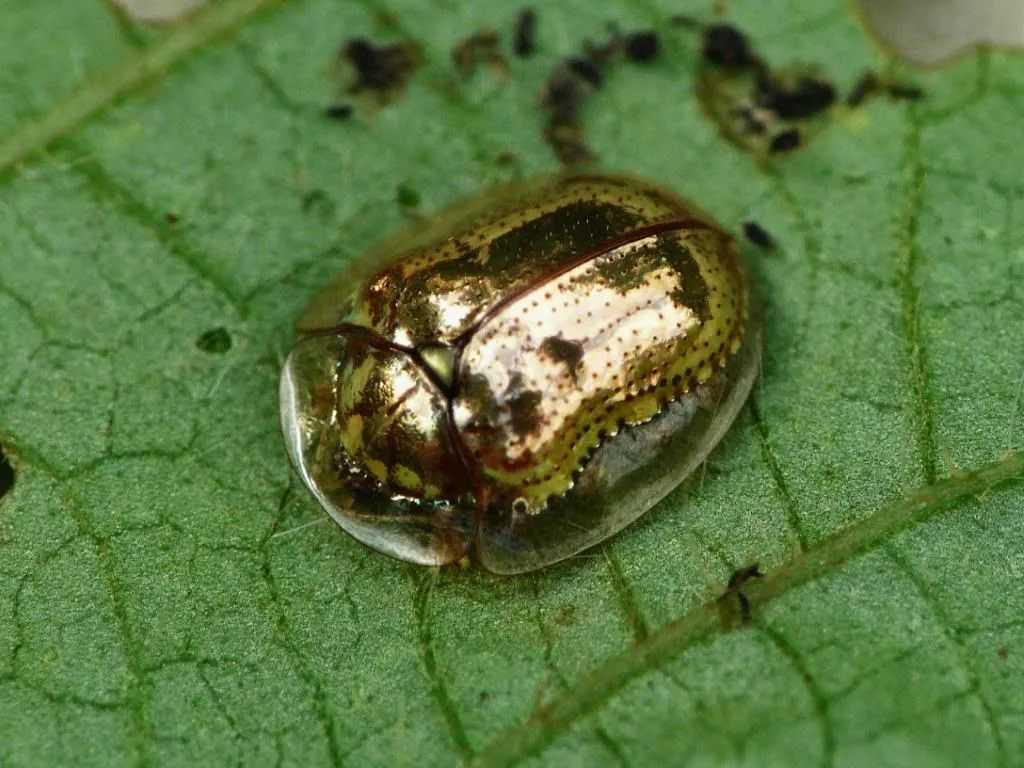
Belonging to the leaf beetle family (Chrysomelidae), the golden tortoise beetle (Charidotella sexpunctata) is a tiny arthropod renowned for its iridescent golden hue and domed, tortoise-like shell. Native to the Americas, this species boasts a remarkably wide distribution, thriving from southern Canada to South America in diverse habitats ranging from farmlands to forests.

A Living Gem: Anatomy and Adaptive Brilliance

  • Metallic Magic: The Science of Iridescence
    The beetle’s elytra (hard wing covers) display a stunning golden sheen, produced by microscopic ridges that refract light. When threatened or stressed, it can alter the moisture between these layers, temporarily turning its shell reddish-brown—a defense mechanism that startles predators. This optical trickery makes it one of nature’s most dynamic color changers among beetles.
  • Tortoise-like Design for Survival
    Growing to just 5–8 mm, its rounded, domed shape resembles a miniature tortoise, providing protection against predators. The edges of its elytra are transparent, creating a "glass-like" border that further confuses attackers. Its legs and body are pale yellow, blending seamlessly with the undersides of leaves where it feeds.

Life Cycle and Ecological Role

  • Feeding Habits and Reproduction
    The golden tortoise beetle primarily feeds on morning glory plants (Convolvulaceae), using its mandibles to scrape leaf tissue. Larvae are less glamorous—spherical and covered in spines, they carry fecal matter on their backs as a deterrent. Adults mate prolifically, laying eggs on host plants, and can undergo multiple generations per year in warm climates.
  • Invasive Potential and Natural Distribution
    While native to the Americas, its adaptability has raised concerns about potential invasions in other continents. In its natural range, it serves as prey for birds, spiders, and parasitic wasps, while also acting as a pollinator and decomposer in plant ecosystems.

Scientific Interest and Cultural Noteworthiness

Researchers study its iridescent properties to develop new materials, from optical coatings to renewable energy technologies. In popular culture, the beetle’s dazzling appearance has made it a subject of nature documentaries and educational campaigns, often celebrated as a living example of evolutionary beauty.


Despite its widespread presence, the golden tortoise beetle faces minor threats from pesticide use and habitat loss. Its resilience and adaptability, however, highlight the tenacity of small creatures in navigating human-altered landscapes—reminding us that even the tiniest jewels of nature hold secrets worth preserving

Latest Stories
Entertainment News1 minute readAnya Taylor-Joy, born April 16, 1996, in Miami, Florida, holds U.S., British, and Argentine citizenship—a global background that mirrors her ability to inhabit diverse roles across film and television.
Animal Information1 minute readThe Atossa fritillary (Speyeria adiaste atossa), a butterfly once common in Southern California’s mountain regions, is feared extinct, with no confirmed sightings since 1959. Characterized by its broad wings decorated with elegant black spots, the species once thrived across the area’s rugged landscapes.
Entertainment News1 minute readMargot Robbie, the Australian actress, ranked 7th in FHM’s 2015 “World’s Sexiest Women” list, a testament to her striking allure that complements her dynamic career.
Sports News1 minute readWith the 2026 Milano Cortina Winter Olympics approaching, full schedules for Winter Sports World Cups and qualifying events are now available. The newly updated Sports Observer calendar includes 699 exclusive events for 2025 and 2026, plus select major competitions through 2034, serving as a key resource for athletes and fans.
Animal Information1 minute readRed foxes, scientifically known as Vulpes vulpes, are among the most widespread and adaptable carnivores on Earth, thriving across diverse habitats from the frozen tundras of the Arctic to the bustling outskirts of urban centers. Their iconic rusty-red coat, white underbelly, and bushy tail—often tipped with white—make them easily distinguishable, while their pointed ears and sharp snouts reflect their keen senses, critical for survival.
Sports News2 minute readThe International Olympic Committee (IOC) has announced the selection of seven research projects for the 11th edition of the Advanced Olympic Research Grant Programme, which is managed by the IOC’s Olympic Studies Centre (OSC). The chosen projects were selected for their academic quality and relevance to the IOC’s defined priority research areas for the Olympic Movement.
Social News1 minute readMyanmar, in Southeast Asia, evokes images of illicit activities like fraud and organ trafficking for many. Yet behind this grim reputation lies a land of immense potential: 680,000 square kilometers of diverse terrain—mountains, plateaus, and river deltas—fringed by 3,200 km of coastline, with the famed Golden Triangle within its borders.