The Indigo Mosquito: South America’s Stunning yet Deadly Rainforest Jewel


Insect Information
The Indigo Mosquito: South America’s Stunning yet Deadly Rainforest Jewel

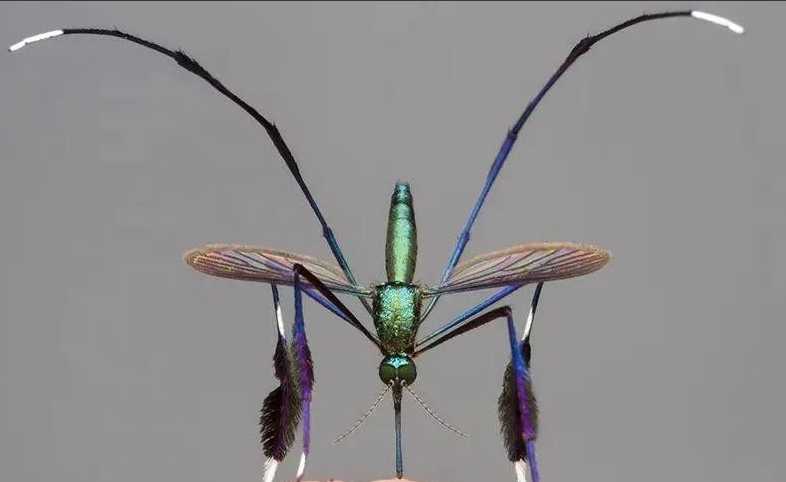
Regarded as the world’s most beautiful mosquito, the indigo mosquito (Sabethes cyaneus) mesmerizes with its iridescent metallic blue and purple hues, while its legs shimmer in feathery scales. Native to South America’s rainforests, this species’ dazzling appearance masks a dangerous reality: it’s a blood-sucking vector of yellow fever, blending aesthetic splendor with biological threat.

A Living Gem: Morphology and Adaptive Radiance

The indigo mosquito’s body shimmers with structural coloration, created by microscopic scales refracting light into vibrant blue, purple, and green tones—an effect rare in mosquitoes. Its most striking feature is the "feathery" hind legs, coated in dense, elongated scales resembling delicate plumes. These scales may aid mating displays or camouflage in rainforest foliage, though their exact function remains unclear.


Growing 8–10 mm, the species shows sexual dimorphism: females have piercing mouthparts for blood-feeding, while males rely on nectar. Unlike most mosquitoes, it has a robust build, adapted to navigating tropical forest understories.

Life Cycle and Dual Ecological Role

Larvae develop in water collected in tree holes or bromeliads, feeding on organic debris. Adults are diurnal, using vivid colors to attract mates. Females require blood meals to lay eggs, targeting mammals, birds, and humans—making them efficient yellow fever vectors. Historically, this has fueled epidemics across South America.


In rainforest ecosystems, the indigo mosquito serves as prey for spiders and amphibians while potentially aiding plant pollination through nectar feeding. This duality—pathogen spread and ecological contribution—highlights its complex role in tropical food webs.

Scientific Fascination and Public Health Imperatives

Entomologists study its iridescent scales for biomimicry insights, while public health experts monitor its behavior to curb yellow fever transmission. Though not endangered, its survival hinges on rainforest preservation. As with many tropical insects, it embodies nature’s paradox: beauty and danger coexisting within Earth’s most biodiverse ecosystems.

Latest Stories
Industry News1 minute readOn July 17, the U.S. House passed two key crypto bills, marking the first major step toward formal industry regulations. The moves aim to legalize digital assets and pave their way to mainstream financial status.
Sports News1 minute readThe International Council of Arbitration for Sport (ICAS) released its 2024 financial statements, clarifying a frequently asked question: How much of the Court of Arbitration for Sport (CAS) funding comes from the IOC? Total operating revenue reached 24.15 million Swiss francs (CHF) (1 CHF = 1.26 USD), with a clear breakdown of sources.
Entertainment News1 minute readScarlett Johansson is set to shine at this year’s festival in dual roles—starring in Wes Anderson’s competition film The Phoenician Scheme and making her directorial debut with Eleanor the Great in the "Un Certain Regard" section. The American icon continues to expand her creative horizons beyond acting.
Life News1 minute readThe hot dog, a staple of American cuisine, is more than just a simple meal—it's a cultural icon with deep roots in culinary history. At its core, a hot dog consists of a grilled or boiled sausage, traditionally a frankfurter, nestled within a soft, elongated bun. This humble combination has evolved into a versatile dish enjoyed across the nation, with regional variations adding unique twists to the classic formula.
Sports News1 minute readAt its semi-annual meeting last month, the Board of the International Testing Agency (ITA) welcomed Ms. Dagmawit Girmay Berhane and reviewed progress on its 2023-2026 strategic plan. As of June, 91% of 152 projects had either been completed or were underway.
Industry News1 minute readThe ongoing tension and volatility in the Middle East are significantly impacting the global shipping industry. On June 24, former U.S. President Donald Trump announced the immediate 生效 of a ceasefire agreement between Israel and Iran, a move that caused international oil prices—previously soaring due to escalating conflicts—to plunge sharply. However, the region's uncertain situation continues to disrupt the shipping sector.
Animal Information2 minute readThe snow leopard, known as the "ghost of the mountains," ranks among the world's most elusive big cats. Inhabiting the Himalayan range and high-altitude regions of Central Asia, they dwell at elevations between 3,000 and 5,500 meters. The extreme cold, rugged terrain, and remote location create a natural geographical barrier, keeping them largely isolated from human contact.