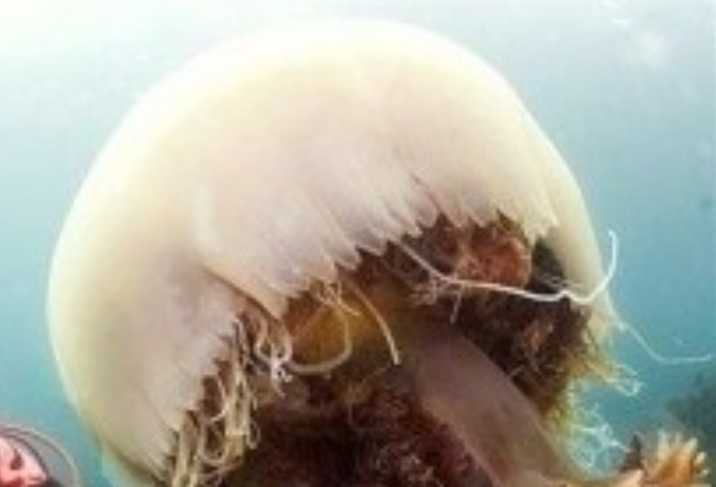
The lion's mane jellyfish (Cyanea capillata) is a majestic and imposing creature, renowned as one of the largest jellyfish species in the world. Found in cold, boreal waters of the Arctic, North Atlantic, and North Pacific oceans, its name stems from its striking appearance—long, flowing tentacles resembling a lion's mane, which give it both beauty and a fearsome reputation as a predator.
- Size and Structure:
The lion's mane jellyfish can reach astounding proportions: its bell (the dome-shaped body) may span up to 2 meters in diameter, while its tentacles—arranged in eight clusters—can stretch up to 30 meters, longer than a blue whale. This massive size makes it a top predator in its ecosystem. The bell is typically reddish-brown or golden, fading to pale pink at the edges, with a frilly oral arm structure beneath that resembles a mane.
- Toxic Tentacles:
Each tentacle is lined with thousands of nematocysts (stinging cells) that inject toxins into prey, such as small fish, plankton, and other jellyfish. The venom is designed to paralyze or kill, allowing the jellyfish to draw prey toward its central mouth with its oral arms. While rarely fatal to humans, encounters can cause painful stings and allergic reactions.
- Metamorphosis and Reproduction:
Starting as tiny planula larvae, they attach to seafloor substrates and grow into polyps, which eventually bud off into ephyrae (young jellyfish). As adults, they reproduce sexually, releasing eggs and sperm into the water. Their lifespan is relatively short, typically surviving one year, with peak size reached in late summer.
- Ecological Impact:
As both predator and prey, lion's mane jellyfish play a key role in marine food webs. They control populations of small marine creatures, while larger animals like sea turtles and sunfish feed on them. Their massive bodies also provide habitat for smaller organisms, such as juvenile fish that seek shelter among their tentacles.
- Threats and Resilience:
While not endangered, lion's mane jellyfish face potential risks from climate change (warmer waters may alter their range) and pollution. Conversely, they can thrive in overfished areas where predators are scarce, sometimes forming large swarms that clog fishing nets or damage industrial equipment.
- Scientific and Cultural Significance:
Their unique physiology—including a simple nervous system and lack of a brain or heart—fascinates researchers studying animal evolution and marine biology. In folklore, their imposing presence has inspired tales of sea monsters, while their ethereal movements in the water continue to captivate divers and ocean enthusiasts.
The lion's mane jellyfish stands as a testament to nature's ability to create both beauty and intimidation in the ocean's depths. Its colossal form and ancient lineage remind humanity of the vast, mysterious world beneath the waves—a world where even the most delicate-looking creatures can wield remarkable power.