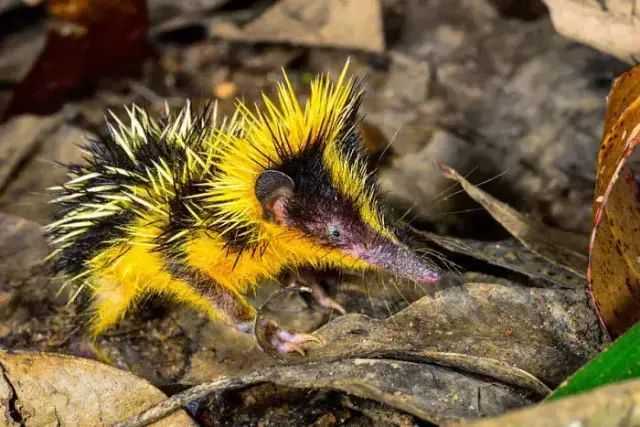
The Lowland Streaked Tenrec: Africa’s Spiky Mammal That 'Sings' by Friction


Animal Information
The Lowland Streaked Tenrec: Africa’s Spiky Mammal That 'Sings' by Friction

Discovered in Madagascar’s lush rainforests, the lowland streaked tenrec (Hemicentetes semispinosus) stands out as a biological oddity: a mammal covered in rigid, porcupine-like quills and the only known species to produce sound by rubbing its spines together. This small, insectivorous creature blends evolutionary innovation with a striking appearance, captivating scientists with its unique acoustic adaptation.


Spines That Strum: The Science of Friction Vocalization

The tenrec’s most remarkable trait is its ability to create high-pitched trills by rubbing specialized quills on its back. These modified spines have ridges and grooves that act like a washboard and stick, producing vibrations when scraped. This behavior, called stridulation, is common in insects but unprecedented in mammals. Researchers believe the tenrec uses these sounds to communicate with mates or warn rivals, with each individual’s "stridulation pattern" potentially serving as a unique identifier. The noise, audible to humans as a faint buzzing, adds a new dimension to mammalian communication—one previously thought exclusive to the insect world.

Armor and Adaptation in Madagascar’s Ecosystem

Measuring 20–30 cm in length, the tenrec’s body is covered in a mix of soft fur and stiff, black-and-white striped quills, providing both camouflage and defense against predators. Its pointed snout and strong claws enable it to dig for insects and earthworms, while webbed hind feet help it navigate wet habitats. Endemic to Madagascar, this tenrec thrives in lowland forests and swamps, where its spiky armor and acoustic trickery have evolved alongside unique island predators. Though listed as Near Threatened due to habitat loss, it remains a symbol of Madagascar’s extraordinary biodiversity—proof that even in the mammalian kingdom, nature finds unexpected ways to communicate and survive.


As scientists study the lowland streaked tenrec, they uncover a world where spines serve not just as armor but as instruments, challenging assumptions about how mammals interact with their environment. Its existence reminds us that Madagascar’s ancient ecosystems continue to harbor secrets—creatures like the tenrec, which blend strangeness with survival in ways that rewrite the rules of biology.

Latest Stories
Entertainment News1 minute readJenna Marie Ortega, born September 27, 2002, in Coachella Valley, California, has emerged as one of Hollywood’s most dynamic young talents. The Latina actress, known for her sharp performances and unapologetic authenticity, continues to redefine teen stardom.
Animal Information1 minute readReporting from Beijing — In 2016, the global scientific community mourned the passing of Xiaoyinghan (Little Tough Guy), the last known Panamanian tree frog (scientific name: Ecnomiohyla panamensis), which breathed its last in an artificial breeding tank at the Atlanta Botanical Garden. The death of this 12-year-old male frog officially marked the complete extinction of the species from Earth.
Sports News1 minute readThe European Court of Human Rights (ECHR) Grand Chamber ruled Thursday that the Court of Arbitration for Sport (CAS) claimed a significant victory, while South African double Olympic 800m champion Caster Semenya achieved a minor win in her long-running legal battle. The "Semenya v Switzerland" case centers on Semenya’s challenge to World Athletics’ rules on athletes with Differences of Sexual Development (DSD).
Sports News1 minute readFINA’s integrity unit revealed this week that Chinese and Russian athletes at the Singapore World Swimming Championships are undergoing at least twice as many anti-doping tests as competitors from other nations. Data shows Chinese swimmers average 8.80 tests per athlete, with Russians at 8.20—far exceeding the U.S. (4.13), Australia (4.00), and Britain (2.20).
Cultural News2 minute readOn July 12, the UNESCO World Heritage Committee officially inscribed four iconic palaces built by Bavaria’s King Ludwig II onto the prestigious World Heritage List. The ensemble includes Neuschwanstein Castle, Herrenchiemsee Palace, Linderhof Palace, and the Schachen Royal Lodge, celebrated for their visionary architecture and cultural significance. Maria Böhmer, President of Germany’s UNESCO Commission, hailed them as “architectural masterpieces that reflect both the artistic imagination of the Fairy-Tale King and his unconventional genius”
Sports News1 minute readThe Icelandic National Olympic Committee (NOC) has announced a €128,000 funding package to cover costs for 285 young athletes representing national teams between January and March. The initiative is part of a broader high-performance sports program approved in late 2023, aiming to boost youth athlete development.
Travel News2 minute readNestled in the sun-drenched Provence region of France, Arles is a 2,100-year-old city where Roman heritage and Van Gogh’s artistic legacy converge. Designated a UNESCO World Heritage Site, it boasts impeccably preserved Roman amphitheaters, theaters, and the Basilica of Saint-Trophime, alongside over 300 masterpieces created by Vincent van Gogh during his transformative stay.