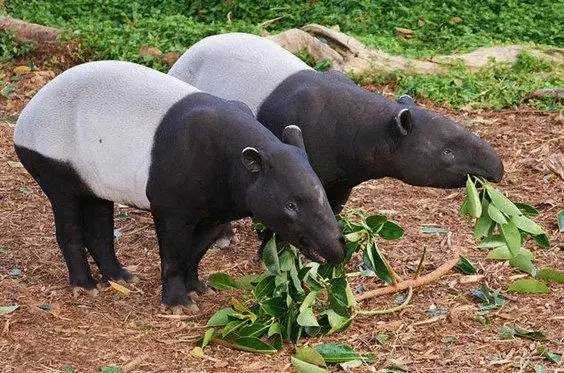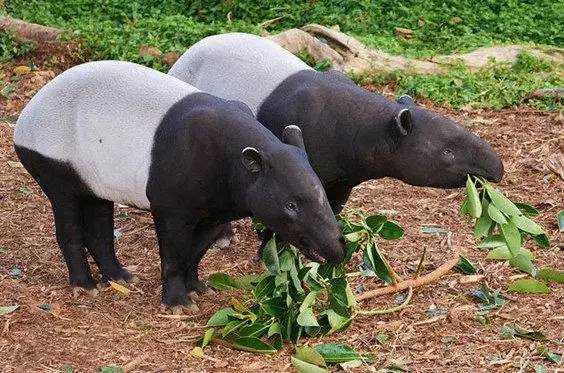
Native to the dense rainforests of Malaysia, Thailand, and Sumatra, the Malayan tapir (Tapirus indicus), also known as the Asian tapir, stands out as one of the region’s most unique and endangered mammals. Recognized by its striking black-and-white coloration and prehensile snout, this large herbivore is often called a "living fossil" due to its ancient lineage and primitive features.
The Malayan tapir’s most iconic trait is its dual-toned coat: a black back and hindquarters contrast with a white band across the midsection, creating a striking pattern that serves as camouflage in dappled forest light. Growing up to 2.5 meters in length and weighing 250–320 kilograms, it has a stocky build, short legs, and a flexible, elephant-like snout used to grasp leaves, twigs, and fruit. Its small eyes and ears belie acute senses of smell and hearing, while thick skin protects it from thorns and insect bites. As one of five tapir species worldwide, it represents a rare link to prehistoric mammals that roamed the earth millions of years ago.
Source: Images from the Internet, if there is any infringement, please contact the removal of
Primarily nocturnal, Malayan tapirs spend their days resting in thick vegetation and foraging at night, often near water sources where they swim and wallow to cool off. They play a vital role as "gardeners of the forest," dispersing seeds through their droppings. However, the species is listed as Endangered by the IUCN, with fewer than 3,000 individuals remaining in the wild. Deforestation for palm oil plantations, logging, and infrastructure development have destroyed 80% of their habitat, while poaching for meat and body parts (believed to have medicinal value) compounds the crisis. Road accidents also pose a significant threat, as tapirs often wander onto highways in search of new feeding grounds.
Conservation organizations like the Malayan Tapir Conservation Project work to protect remaining populations through habitat restoration, anti-poaching patrols, and the construction of wildlife corridors. Captive breeding programs in zoos aim to maintain genetic diversity, though reintroducing tapirs to the wild remains challenging. Local communities are increasingly involved in conservation, with initiatives like ecotourism highlighting the tapir’s role in maintaining forest health.
The Malayan tapir’s existence serves as a poignant reminder of Southeast Asia’s vanishing rainforests. Its unique appearance and ancient lineage make it a symbol of biodiversity worth fighting for, but urgent action is needed to prevent this "living fossil" from disappearing within a generation. As deforestation continues, the tapir’s black-and-white form may soon become a ghost of the forest—unless global efforts align to preserve its fragile habitat.