The Rainbow Stag Beetle (Phalacrognathus muelleri): Nature's Living Jewel


Insect Information
The Rainbow Stag Beetle (Phalacrognathus muelleri): Nature's Living Jewel

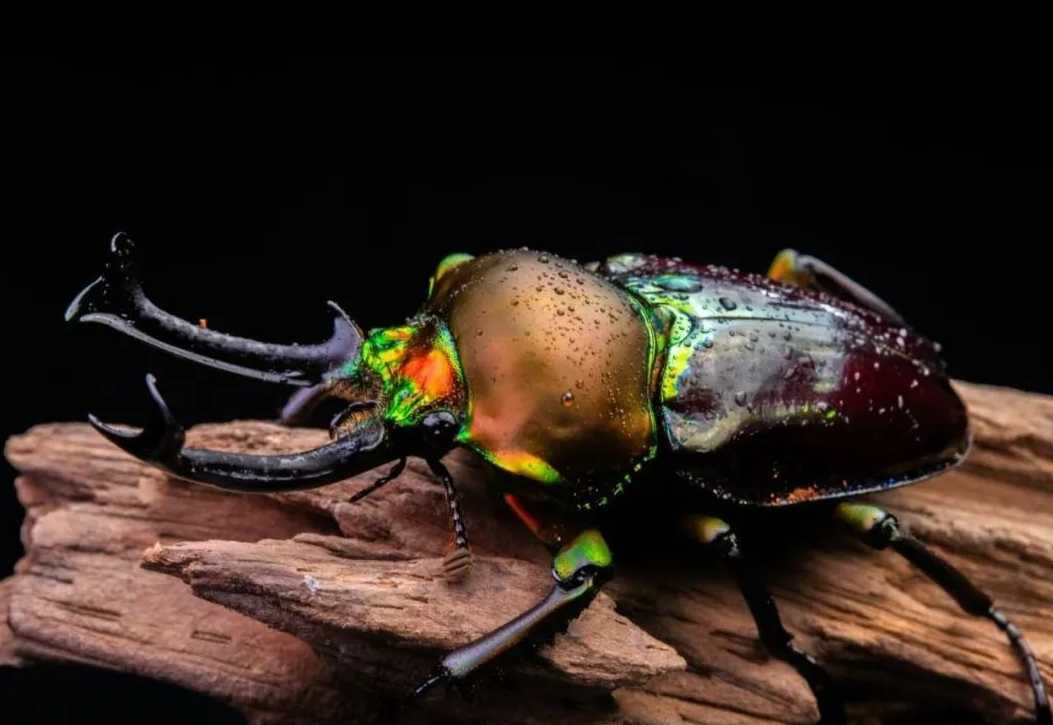
The rainbow stag beetle, Phalacrognathus muelleri, is a biological marvel renowned for its iridescent metallic hues that rival precious gems. Native to the forests of Australia and New Guinea, this coleopteran species has captivated entomologists and pet enthusiasts alike with its structural coloration—a phenomenon produced by microscopic wing surface ridges that refract light into a spectrum of blues, purples, golds, and greens.


A Masterpiece of Structural Coloration
Unlike pigments, the beetle’s vibrant hues arise from physical structures on its exoskeleton. The elytra and ventral surface feature nano-scale layers that interfere with light waves, creating dynamic color shifts as viewing angles change. This optical adaptation, similar to that of peacock feathers, serves dual purposes: camouflage among rainforest foliage and visual signaling during mating. Adults measure 30–60 mm, with males sporting enlarged mandibles that resemble antlers—though these are used more for display than combat.


From Forests to Terrariums: A Popular Pet
Thanks to selective breeding, captive populations now exhibit variants in red, black, and purple tones, expanding the natural color palette. Breeders have harnessed the beetle’s robust nature and relatively simple life cycle—larvae feed on decaying wood, while adults survive on nectar and tree sap—to meet demand. Their docile temperament and low maintenance needs have made them sought-after pets, with enthusiasts creating specialized habitats to mimic their native eucalyptus forests. However, wild populations are protected in some regions, emphasizing the importance of sustainable captive breeding.


Ecological and Technological Inspiration
In the wild, Phalacrognathus muelleri plays a crucial role in forest ecosystems as decomposers, aiding in nutrient cycling. Their structural coloration has also inspired materials science: researchers study the nano-scale architecture of their exoskeletons to develop sustainable iridescent coatings and energy-efficient optical devices. From its role as a forest recycler to its status as a living work of art, the rainbow stag beetle embodies the intersection of biological beauty and human fascination—proving that nature’s most vivid creations often hold the key to both ecological balance and technological innovation.

Latest Stories
Entertainment News1 minute readJenna Marie Ortega, born September 27, 2002, in Coachella Valley, California, has emerged as one of Hollywood’s most dynamic young talents. The Latina actress, known for her sharp performances and unapologetic authenticity, continues to redefine teen stardom.
Animal Information1 minute readReporting from Beijing — In 2016, the global scientific community mourned the passing of Xiaoyinghan (Little Tough Guy), the last known Panamanian tree frog (scientific name: Ecnomiohyla panamensis), which breathed its last in an artificial breeding tank at the Atlanta Botanical Garden. The death of this 12-year-old male frog officially marked the complete extinction of the species from Earth.
Sports News1 minute readThe European Court of Human Rights (ECHR) Grand Chamber ruled Thursday that the Court of Arbitration for Sport (CAS) claimed a significant victory, while South African double Olympic 800m champion Caster Semenya achieved a minor win in her long-running legal battle. The "Semenya v Switzerland" case centers on Semenya’s challenge to World Athletics’ rules on athletes with Differences of Sexual Development (DSD).
Sports News1 minute readFINA’s integrity unit revealed this week that Chinese and Russian athletes at the Singapore World Swimming Championships are undergoing at least twice as many anti-doping tests as competitors from other nations. Data shows Chinese swimmers average 8.80 tests per athlete, with Russians at 8.20—far exceeding the U.S. (4.13), Australia (4.00), and Britain (2.20).
Cultural News2 minute readOn July 12, the UNESCO World Heritage Committee officially inscribed four iconic palaces built by Bavaria’s King Ludwig II onto the prestigious World Heritage List. The ensemble includes Neuschwanstein Castle, Herrenchiemsee Palace, Linderhof Palace, and the Schachen Royal Lodge, celebrated for their visionary architecture and cultural significance. Maria Böhmer, President of Germany’s UNESCO Commission, hailed them as “architectural masterpieces that reflect both the artistic imagination of the Fairy-Tale King and his unconventional genius”
Sports News1 minute readThe Icelandic National Olympic Committee (NOC) has announced a €128,000 funding package to cover costs for 285 young athletes representing national teams between January and March. The initiative is part of a broader high-performance sports program approved in late 2023, aiming to boost youth athlete development.
Travel News2 minute readNestled in the sun-drenched Provence region of France, Arles is a 2,100-year-old city where Roman heritage and Van Gogh’s artistic legacy converge. Designated a UNESCO World Heritage Site, it boasts impeccably preserved Roman amphitheaters, theaters, and the Basilica of Saint-Trophime, alongside over 300 masterpieces created by Vincent van Gogh during his transformative stay.