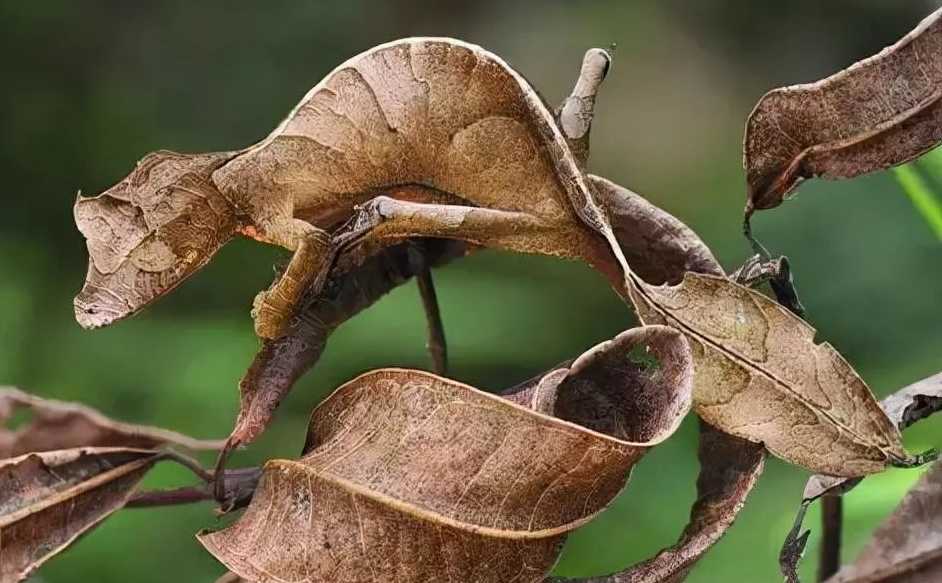
The Satanic Leaf-Tailed Gecko: A Master of Camouflage Named for Its Dead-Leaf Tail


Insect Information
The Satanic Leaf-Tailed Gecko: A Master of Camouflage Named for Its Dead-Leaf Tail

Native to the rainforests of Madagascar, the Satanic leaf-tailed gecko (Uroplatus phantasticus) earns its dramatic name from a tail that perfectly mimics a decaying leaf—ripped edges, veins, and even brownish "spots" that blend seamlessly with forest litter. This nocturnal reptile, one of the most iconic examples of evolutionary camouflage, has captivated herpetologists and nature enthusiasts with its otherworldly appearance and cryptic lifestyle.


A Tail That Defies Reality: Adaptations for Deception

The gecko’s most striking feature is its broad, flattened tail, which mirrors the texture, color, and shape of a dried leaf. Jagged edges resemble tears from insect bites, while pigmentation ranges from olive-green to reddish-brown, often with blotches that mimic fungal growth. This tail, combined with a body covered in rough, bark-like scales, allows the gecko to cling to tree trunks or lie motionless on the forest floor, invisible to predators and prey alike. Large, lidless eyes with vertical pupils enhance night vision, while toe pads equipped with microscopic hairs let it climb smooth surfaces without a sound.

Nocturnal Hunter and Cryptic Behavior

Active at night, the Satanic leaf-tailed gecko preys on insects, spiders, and small vertebrates, using its camouflage to ambush unsuspecting prey. During the day, it rests motionless, often positioned at an angle to resemble a fallen leaf, with its tail curled to complete the illusion. If threatened, it may open its bright red mouth, hiss, or drop its tail (which regenerates over time) to distract predators. Despite its ominous name, it is harmless to humans, relying entirely on stealth for survival. Females lay just two eggs per clutch, burying them in leaf litter or under bark—a risky strategy that underscores the importance of perfect camouflage for offspring.

Conservation Challenges in Madagascar’s Rainforests

Endemic to Madagascar, this gecko is listed as Endangered by the IUCN, facing grave threats from deforestation and habitat fragmentation. Logging, agriculture, and charcoal production destroy its forest home, while illegal collection for the pet trade compounds the crisis. Conservation organizations work to protect remaining rainforests and promote sustainable practices, emphasizing that the gecko’s survival is tied to the health of Madagascar’s unique ecosystems. Its remarkable camouflage, evolved over millions of years, serves as a reminder of nature’s ingenuity—but also of the fragility of species that depend on specific, threatened habitats.


For biologists, the Satanic leaf-tailed gecko is a living testament to natural selection’s power to craft perfection in disguise. Its leaf-like tail, once thought to inspire its "Satanic" moniker due to its eerie realism, now serves as a symbol of Madagascar’s irreplaceable biodiversity. As deforestation threatens to turn this living leaf into a mere fossil, the gecko’s silent presence in the rainforest canopy stands as both a marvel of adaptation and a urgent call to protect the wild places where such evolutionary wonders still thrive.
Latest Stories
Entertainment News1 minute readJenna Marie Ortega, born September 27, 2002, in Coachella Valley, California, has emerged as one of Hollywood’s most dynamic young talents. The Latina actress, known for her sharp performances and unapologetic authenticity, continues to redefine teen stardom.
Animal Information1 minute readReporting from Beijing — In 2016, the global scientific community mourned the passing of Xiaoyinghan (Little Tough Guy), the last known Panamanian tree frog (scientific name: Ecnomiohyla panamensis), which breathed its last in an artificial breeding tank at the Atlanta Botanical Garden. The death of this 12-year-old male frog officially marked the complete extinction of the species from Earth.
Sports News1 minute readThe European Court of Human Rights (ECHR) Grand Chamber ruled Thursday that the Court of Arbitration for Sport (CAS) claimed a significant victory, while South African double Olympic 800m champion Caster Semenya achieved a minor win in her long-running legal battle. The "Semenya v Switzerland" case centers on Semenya’s challenge to World Athletics’ rules on athletes with Differences of Sexual Development (DSD).
Sports News1 minute readFINA’s integrity unit revealed this week that Chinese and Russian athletes at the Singapore World Swimming Championships are undergoing at least twice as many anti-doping tests as competitors from other nations. Data shows Chinese swimmers average 8.80 tests per athlete, with Russians at 8.20—far exceeding the U.S. (4.13), Australia (4.00), and Britain (2.20).
Cultural News2 minute readOn July 12, the UNESCO World Heritage Committee officially inscribed four iconic palaces built by Bavaria’s King Ludwig II onto the prestigious World Heritage List. The ensemble includes Neuschwanstein Castle, Herrenchiemsee Palace, Linderhof Palace, and the Schachen Royal Lodge, celebrated for their visionary architecture and cultural significance. Maria Böhmer, President of Germany’s UNESCO Commission, hailed them as “architectural masterpieces that reflect both the artistic imagination of the Fairy-Tale King and his unconventional genius”
Sports News1 minute readThe Icelandic National Olympic Committee (NOC) has announced a €128,000 funding package to cover costs for 285 young athletes representing national teams between January and March. The initiative is part of a broader high-performance sports program approved in late 2023, aiming to boost youth athlete development.
Travel News2 minute readNestled in the sun-drenched Provence region of France, Arles is a 2,100-year-old city where Roman heritage and Van Gogh’s artistic legacy converge. Designated a UNESCO World Heritage Site, it boasts impeccably preserved Roman amphitheaters, theaters, and the Basilica of Saint-Trophime, alongside over 300 masterpieces created by Vincent van Gogh during his transformative stay.