Ecuador’s 'Popcorn Bug': Flying Planthopper Nymphs Defy Predators with Waxy Camouflage


Insect Information
Ecuador’s 'Popcorn Bug': Flying Planthopper Nymphs Defy Predators with Waxy Camouflage

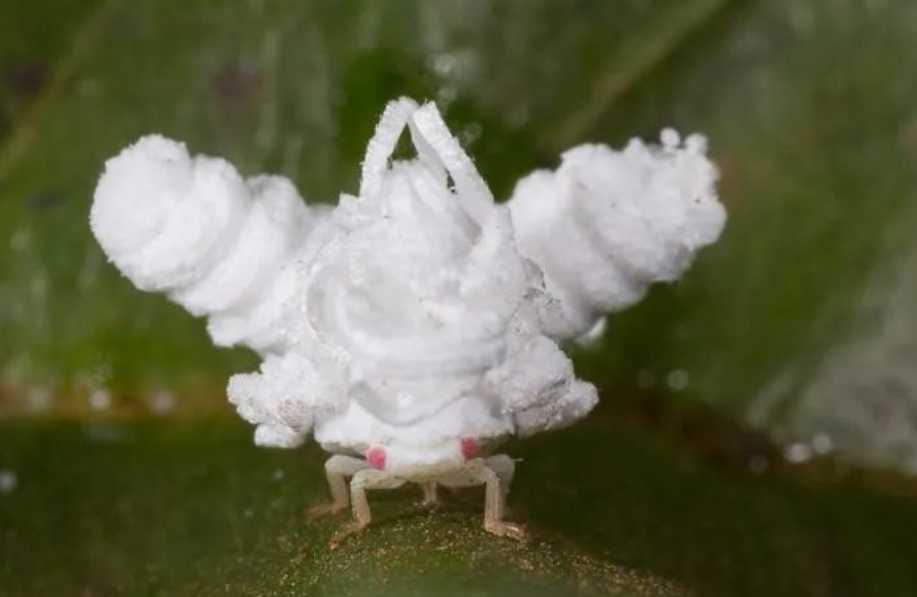
Deep in Ecuador’s cloud forests, a tiny insect nicknamed the "popcorn bug" has captivated scientists with its uncanny resemblance to a flying kernel of popcorn. The nymph stage of a Fulgoridae planthopper, it secretes a fluffy waxy coating that transforms it into a living mimic of bird droppings or spider cocoons—while flitting through the air like a speck of popped corn. Discovered in the Andean foothills, this insect’s survival strategy showcases nature’s most whimsical defenses.


A Living Popcorn Kernel: Anatomy and Camouflage

Measuring 5–8 mm, the planthopper nymph is encased in a waxy secretion resembling popped corn. Produced by abdominal glands, this coating mimics inedible bird droppings to deter predators and insulates against moisture loss. When threatened, it launches into short, erratic flights, its white wax particles catching light to mimic floating popcorn.


Beneath the wax, its pale yellow or green body matches young plant stems. Adapted legs cling to leaves, while antennae detect approaching threats. Unusually for nymphs, it develops rudimentary wing pads early, enabling aerial escapes—rare in its family.

Cloud Forest Ecology and Scientific Promise

Native to Ecuador’s Mindo-Nambillo reserve, the popcorn bug feeds on plant sap with piercing mouthparts. Its wax secretion traps beneficial bacteria for digestion. Females lay eggs under leaves, coating them in wax to fend off fungi.


Though not endangered, it faces risks from deforestation and pesticides. Scientists study its wax glands for biomimicry, seeking to replicate their water-repellent properties. For locals, it symbolizes cloud forest biodiversity, fueling eco-tourism that balances conservation with community needs.


In Ecuador’s misty canopies, this insect proves nature’s survival tactics come in unexpected forms. Like living popcorn, the planthopper nymph reminds us that even tiny creatures hold secrets worth protecting in Earth’s fragile ecosystems.

Latest Stories
Entertainment News1 minute readIndie favorite Kristen Stewart, known for collaborations with Kelly Reichardt and Olivier Assayas, steps behind the camera for The Chronology of Water, premiering in Un Certain Regard. Adapted from Lydia Yuknavitch’s memoir, the film has earned early acclaim.
Travel News2 minute readNestled in the Vosges Mountains of Haute-Saône, France, the Plateau des Mille Etangs (Thousand Ponds Plateau) is emerging as a top destination for discerning hikers. Shaped by glaciers and human history, this 220 km² region boasts a surreal landscape of lakes, forests, and peat bogs, earning it the nickname "Little Finland" .
Animal Information1 minute readThe four-eyed turtle (Sacalia quadriocellata), a rare freshwater reptile native to Southeast Asia, has captured global attention for its distinctive appearance and critical endangered status. Contrary to its common name, this small turtle—typically measuring under 20 centimeters in length—possesses only two functional eyes. Its moniker derives from four striking ocelli (eye-like spots) atop its head: two pairs of bright yellow markings ringed with dark pigment, resembling additional eyes and forming one of nature’s most intriguing examples of mimicry.
Animal Information1 minute readWELLINGTON, July 17 (Xinhua) -- The Okarito brown kiwi (Apteryx rowi), a flightless bird endemic to New Zealand, is teetering on the brink of a growing survival crisis. Classified as "Vulnerable" by the International Union for Conservation of Nature (IUCN), this unique species is grappling with relentless threats from invasive predators like stoats, which have wreaked havoc on their nests and chicks, putting the entire population at risk.
Sports News1 minute readThe International Council of Arbitration for Sport (ICAS) released its 2024 financial statements, clarifying a frequently asked question: How much of the Court of Arbitration for Sport (CAS) funding comes from the IOC? Total operating revenue reached 24.15 million Swiss francs (CHF) (1 CHF = 1.26 USD), with a clear breakdown of sources.
Sports News1 minute readThe Scalo Romana Olympic Village is set to welcome athletes for this winter’s games, having been completed in 900 days—one month ahead of schedule, according to Designboom. The milestone marks a key step in preparations for the Milano Cortina 2026 Winter Olympics.
Industry News1 minute readThe global toy market is poised for steady growth, projected to rise from $316.14 billion in 2024 to $445.97 billion by 2032, at a compound annual growth rate (CAGR) of 4.33%, according to latest insights.