Four-Eyed Turtle: A Unique Freshwater Species Teeters on the Brink of Extinction


Animal Information
Four-Eyed Turtle: A Unique Freshwater Species Teeters on the Brink of Extinction

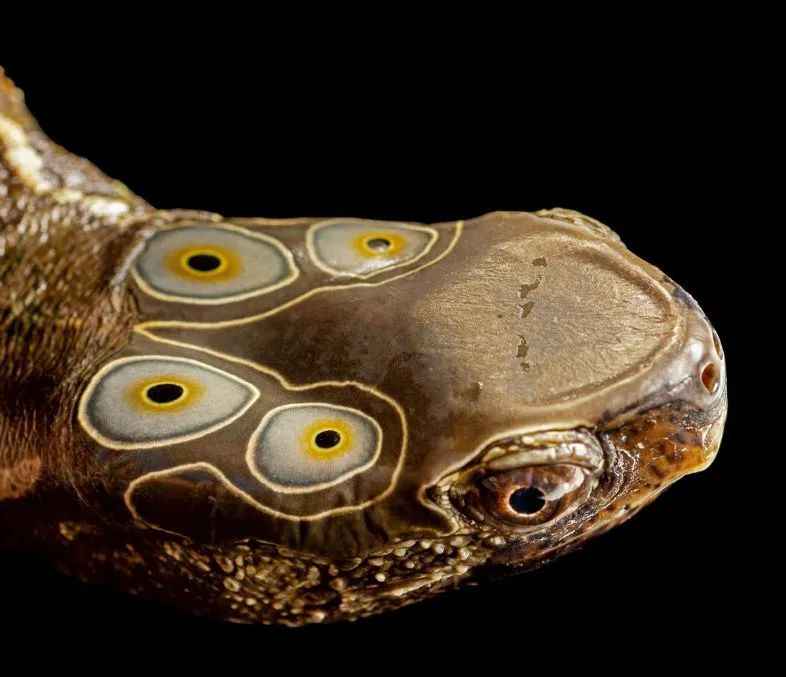
The four-eyed turtle (Sacalia quadriocellata), a rare freshwater reptile native to Southeast Asia, has captured global attention for its distinctive appearance and critical endangered status. Contrary to its common name, this small turtle—typically measuring under 20 centimeters in length—possesses only two functional eyes. Its moniker derives from four striking ocelli (eye-like spots) atop its head: two pairs of bright yellow markings ringed with dark pigment, resembling additional eyes and forming one of nature’s most intriguing examples of mimicry.


Scientists believe these ocelli serve as a survival adaptation. When threatened by predators such as birds or snakes, the turtle retracts its head into its shell, leaving the spots exposed to confuse attackers—potentially misleading them about the turtle’s size or intended movement. The markings may also play a role in communication during mating seasons, helping individuals recognize conspecifics.


Inhabiting clear, fast-flowing mountain streams, marshes, and humid forest ecosystems, the four-eyed turtle ranges across southern China, northeastern Vietnam, and parts of Laos. Its diet consists of insects, small crustaceans, and aquatic plant matter, reflecting its dependence on pristine freshwater habitats. However, wild populations have plummeted in recent decades due to habitat loss and illegal exploitation.


Classified as "Endangered" on the IUCN Red List and listed in Appendix II of CITES (Convention on International Trade in Endangered Species), the species faces severe threats from habitat fragmentation—caused by dam construction, agricultural expansion, and water pollution—and poaching for the illegal pet trade, where its unique appearance makes it a coveted specimen. Traditional medicinal uses further exacerbate its decline.


Conservation efforts are underway, with research institutions in China and Vietnam launching captive breeding and reintroduction programs. Community outreach initiatives aim to reduce local exploitation, while habitat restoration projects target critical watersheds. Experts warn that without strengthened cross-border collaboration and stricter enforcement against illegal trade, this enigmatic "four-eyed" species could vanish from the wild within decades.

Latest Stories
Life News2 minute readIn Valencia, a coastal city in eastern Spain, a dish has transcended its role as mere food to become a symbol of the city's culture and identity—Spanish paella. Hailed as Valencia's proud signature cuisine, this delicacy not only carries the region's historical memories but has also captivated global palates with its unique flavors.
Travel News2 minute readWarsaw's Old Town (Polish: Stare Miasto), the oldest district of Poland's capital, embodies a nation's phoenix-like resilience. In August 1944, Nazi forces systematically destroyed 85% of this 600-year-old city during the Warsaw Uprising, leaving only rubble and ashes . Yet, over two decades, the Polish people meticulously reconstructed it to its pre-war glory, earning its place on the UNESCO World Heritage List in 1980 as "an outstanding example of near-total reconstruction spanning the 13th to 20th centuries" .
Animal Information1 minute readIn the high-altitude waters of the Andes, a remarkable amphibian clings to survival against daunting odds. The Titicaca water frog (Telmatobius culeus), listed as critically endangered by conservation authorities, has evolved a striking adaptation to thrive in one of the harshest aquatic environments on Earth.
Social News1 minute readMyanmar, in Southeast Asia, evokes images of illicit activities like fraud and organ trafficking for many. Yet behind this grim reputation lies a land of immense potential: 680,000 square kilometers of diverse terrain—mountains, plateaus, and river deltas—fringed by 3,200 km of coastline, with the famed Golden Triangle within its borders.
Life News1 minute readKnown as "dolsot bibimbap," "Korean mixed rice," or "stone bowl bibimbap," this dish is a quintessential rice-based cuisine of the Korean Peninsula. Its roots can be traced to Jeonju, a city in the southern part of the peninsula, and it has since evolved into a representative food of Korean culture, with Jeonju's version gaining worldwide renown.
Entertainment News1 minute readErika Linder, born May 11, 1990, in Stockholm, Sweden, is a model and actor celebrated for her striking androgynous style. Standing at 175cm, she’s earned the nickname "Female Leonardo DiCaprio" for her resemblance to the Hollywood star—though her fame runs far deeper than looks.
Industry News1 minute readSouth Korea's retail sector showed signs of recovery in May, with offline sales returning to growth after a four-month slump, driven by strong demand for high-value products, data from the Ministry of Trade, Industry and Energy revealed on Wednesday.