The Leatherback Turtle: Earth’s Colossal Marine Reptile Without a Traditional Shell


Animal Information
The Leatherback Turtle: Earth’s Colossal Marine Reptile Without a Traditional Shell

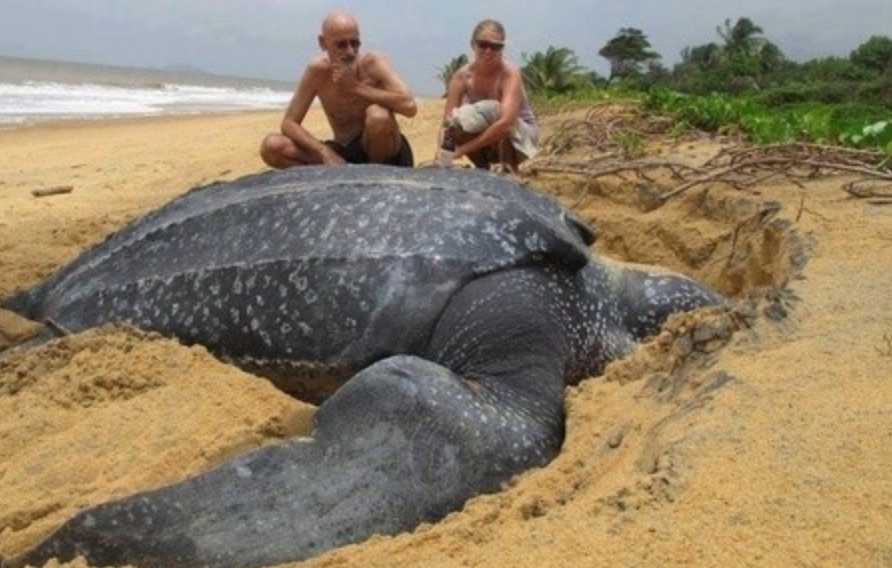
The leatherback turtle (Dermochelys coriacea) holds the title of the world’s largest turtle, capable of weighing up to 900 kilograms. Unlike other turtles, it lacks a hard bony shell. Instead, its back is supported by a flexible framework of bones covered by thick, rubbery skin, giving it a unique, leathery appearance that distinguishes it from all other chelonians.

An Evolutionary Marvel: Adaptations for Oceanic Life

  • Shell Structure Redefined
    The leatherback’s "shell" is a mosaic of bony plates beneath dark, pebbled skin, topped by seven longitudinal ridges. This design reduces drag in water, allowing it to dive to depths of over 1,000 meters—deeper than any other turtle. Its body is streamlined for transoceanic journeys, with flippers spanning up to 2.7 meters, enabling it to migrate thousands of kilometers each year.
  • Thermoregulation Superpowers
    As a semi-endothermic animal, the leatherback maintains body heat in cold oceans through adaptations like a thick layer of fat and efficient blood vessel arrangements. This allows it to thrive in waters where other turtles would freeze, making it a true master of extreme environments.

Global Wanderer and Conservation Concerns

  • Diet and Life Cycle
    Primarily feeding on jellyfish, the leatherback plays a crucial role in controlling jellyfish populations. Females return to tropical beaches to nest, digging pits and laying up to 100 eggs per clutch. Hatchlings face numerous threats, from predatory crabs to artificial lighting that disorients them from the sea.
  • Threats to Survival
    Listed as "Vulnerable" by the IUCN, the leatherback confronts multiple perils: plastic pollution (mistaken for jellyfish), habitat loss from coastal development, and climate change (which skews egg sex ratios). Fishing gear entanglement also poses a significant risk, with thousands dying annually in commercial nets.


Despite its massive size and ancient lineage (dating back 100 million years), the leatherback’s future hinges on human action. Conservation initiatives—including beach patrols, net modifications, and plastic reduction campaigns—aim to protect this ocean giant, ensuring that Earth’s last leatherback turtles continue to traverse the world’s seas for generations to come.

Latest Stories
Entertainment News1 minute readIndie favorite Kristen Stewart, known for collaborations with Kelly Reichardt and Olivier Assayas, steps behind the camera for The Chronology of Water, premiering in Un Certain Regard. Adapted from Lydia Yuknavitch’s memoir, the film has earned early acclaim.
Travel News2 minute readNestled in the Vosges Mountains of Haute-Saône, France, the Plateau des Mille Etangs (Thousand Ponds Plateau) is emerging as a top destination for discerning hikers. Shaped by glaciers and human history, this 220 km² region boasts a surreal landscape of lakes, forests, and peat bogs, earning it the nickname "Little Finland" .
Animal Information1 minute readThe four-eyed turtle (Sacalia quadriocellata), a rare freshwater reptile native to Southeast Asia, has captured global attention for its distinctive appearance and critical endangered status. Contrary to its common name, this small turtle—typically measuring under 20 centimeters in length—possesses only two functional eyes. Its moniker derives from four striking ocelli (eye-like spots) atop its head: two pairs of bright yellow markings ringed with dark pigment, resembling additional eyes and forming one of nature’s most intriguing examples of mimicry.
Animal Information1 minute readWELLINGTON, July 17 (Xinhua) -- The Okarito brown kiwi (Apteryx rowi), a flightless bird endemic to New Zealand, is teetering on the brink of a growing survival crisis. Classified as "Vulnerable" by the International Union for Conservation of Nature (IUCN), this unique species is grappling with relentless threats from invasive predators like stoats, which have wreaked havoc on their nests and chicks, putting the entire population at risk.
Sports News1 minute readThe International Council of Arbitration for Sport (ICAS) released its 2024 financial statements, clarifying a frequently asked question: How much of the Court of Arbitration for Sport (CAS) funding comes from the IOC? Total operating revenue reached 24.15 million Swiss francs (CHF) (1 CHF = 1.26 USD), with a clear breakdown of sources.
Sports News1 minute readThe Scalo Romana Olympic Village is set to welcome athletes for this winter’s games, having been completed in 900 days—one month ahead of schedule, according to Designboom. The milestone marks a key step in preparations for the Milano Cortina 2026 Winter Olympics.
Industry News1 minute readThe global toy market is poised for steady growth, projected to rise from $316.14 billion in 2024 to $445.97 billion by 2032, at a compound annual growth rate (CAGR) of 4.33%, according to latest insights.