The Sunda Colugo: An Indonesian Native That's Neither a Monkey Nor a True Flyer


Animal Information
The Sunda Colugo: An Indonesian Native That's Neither a Monkey Nor a True Flyer

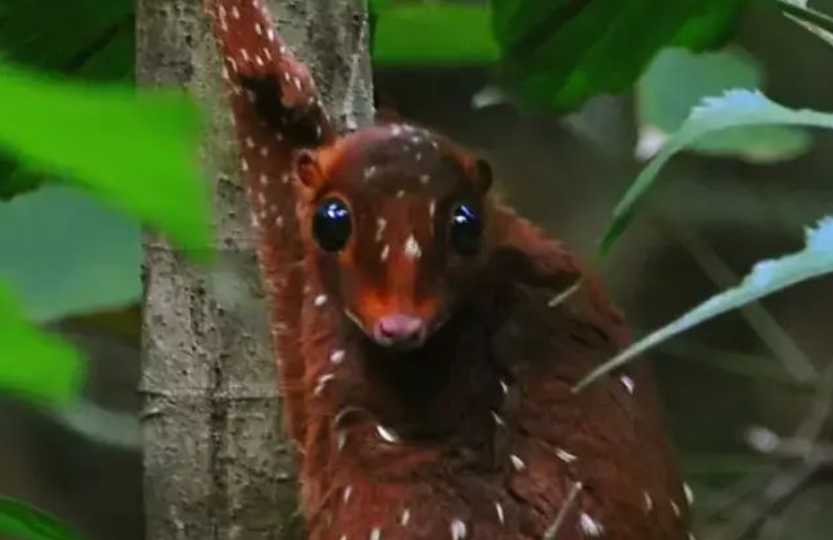
Native to the rainforests of Indonesia, Malaysia, and Thailand, the Sunda colugo (Galeopterus variegatus) confuses observers with its misleading name. Despite being called a "cat monkey" in some regions, this arboreal mammal belongs to the order Dermoptera—and rather than flying, it performs an astonishing glide that spans up to 100 meters between trees.


A Gliding Specialist with a Misleading Moniker

The colugo’s most remarkable feature is its patagium—a stretch of skin extending from its wrists to ankles, forming a parachute-like membrane that allows it to glide between trees. This adaptation, more efficient than the glides of flying squirrels, lets it navigate dense forests without descending to the ground. Contrary to its "monkey" label, it lacks a tail and has claws instead of grasping hands, resembling a large flying squirrel more than a primate. Its face, with large eyes and a rounded snout, gives it a cat-like appearance, hence the nickname "flying lemur"—though it’s unrelated to lemurs too.

Nocturnal Life and Conservation Threats

Active at night, the Sunda colugo feeds on leaves, flowers, and tree sap, using its sharp teeth to scrape bark. It sleeps during the day, curled in tree hollows or under branches, relying on camouflage to avoid predators like clouded leopards and eagles. Despite its impressive gliding skills, it cannot generate lift like birds or bats, making it a master of controlled descent rather than true flight. Deforestation poses the gravest threat to colugos, as habitat fragmentation destroys their glide paths and food sources. Listed as Near Threatened by the IUCN, they depend on intact rainforests to survive—a reminder that Indonesia’s rich biodiversity includes creatures that defy easy classification.


For biologists, the Sunda colugo is a testament to evolutionary innovation: a mammal that conquered the canopy not by flying, but by perfecting the art of gliding. Its existence challenges our assumptions about taxonomic labels, proving that nature’s most fascinating creatures often thrive in the gaps between categories. As deforestation threatens its home, the colugo’s silent glide through the treetops serves as both a marvel of adaptation and a warning about the fragility of Earth’s unique species.

Latest Stories
Entertainment News1 minute readAnya Taylor-Joy, born April 16, 1996, in Miami, Florida, holds U.S., British, and Argentine citizenship—a global background that mirrors her ability to inhabit diverse roles across film and television.
Animal Information1 minute readThe Atossa fritillary (Speyeria adiaste atossa), a butterfly once common in Southern California’s mountain regions, is feared extinct, with no confirmed sightings since 1959. Characterized by its broad wings decorated with elegant black spots, the species once thrived across the area’s rugged landscapes.
Entertainment News1 minute readMargot Robbie, the Australian actress, ranked 7th in FHM’s 2015 “World’s Sexiest Women” list, a testament to her striking allure that complements her dynamic career.
Sports News1 minute readWith the 2026 Milano Cortina Winter Olympics approaching, full schedules for Winter Sports World Cups and qualifying events are now available. The newly updated Sports Observer calendar includes 699 exclusive events for 2025 and 2026, plus select major competitions through 2034, serving as a key resource for athletes and fans.
Animal Information1 minute readRed foxes, scientifically known as Vulpes vulpes, are among the most widespread and adaptable carnivores on Earth, thriving across diverse habitats from the frozen tundras of the Arctic to the bustling outskirts of urban centers. Their iconic rusty-red coat, white underbelly, and bushy tail—often tipped with white—make them easily distinguishable, while their pointed ears and sharp snouts reflect their keen senses, critical for survival.
Sports News2 minute readThe International Olympic Committee (IOC) has announced the selection of seven research projects for the 11th edition of the Advanced Olympic Research Grant Programme, which is managed by the IOC’s Olympic Studies Centre (OSC). The chosen projects were selected for their academic quality and relevance to the IOC’s defined priority research areas for the Olympic Movement.
Social News1 minute readMyanmar, in Southeast Asia, evokes images of illicit activities like fraud and organ trafficking for many. Yet behind this grim reputation lies a land of immense potential: 680,000 square kilometers of diverse terrain—mountains, plateaus, and river deltas—fringed by 3,200 km of coastline, with the famed Golden Triangle within its borders.